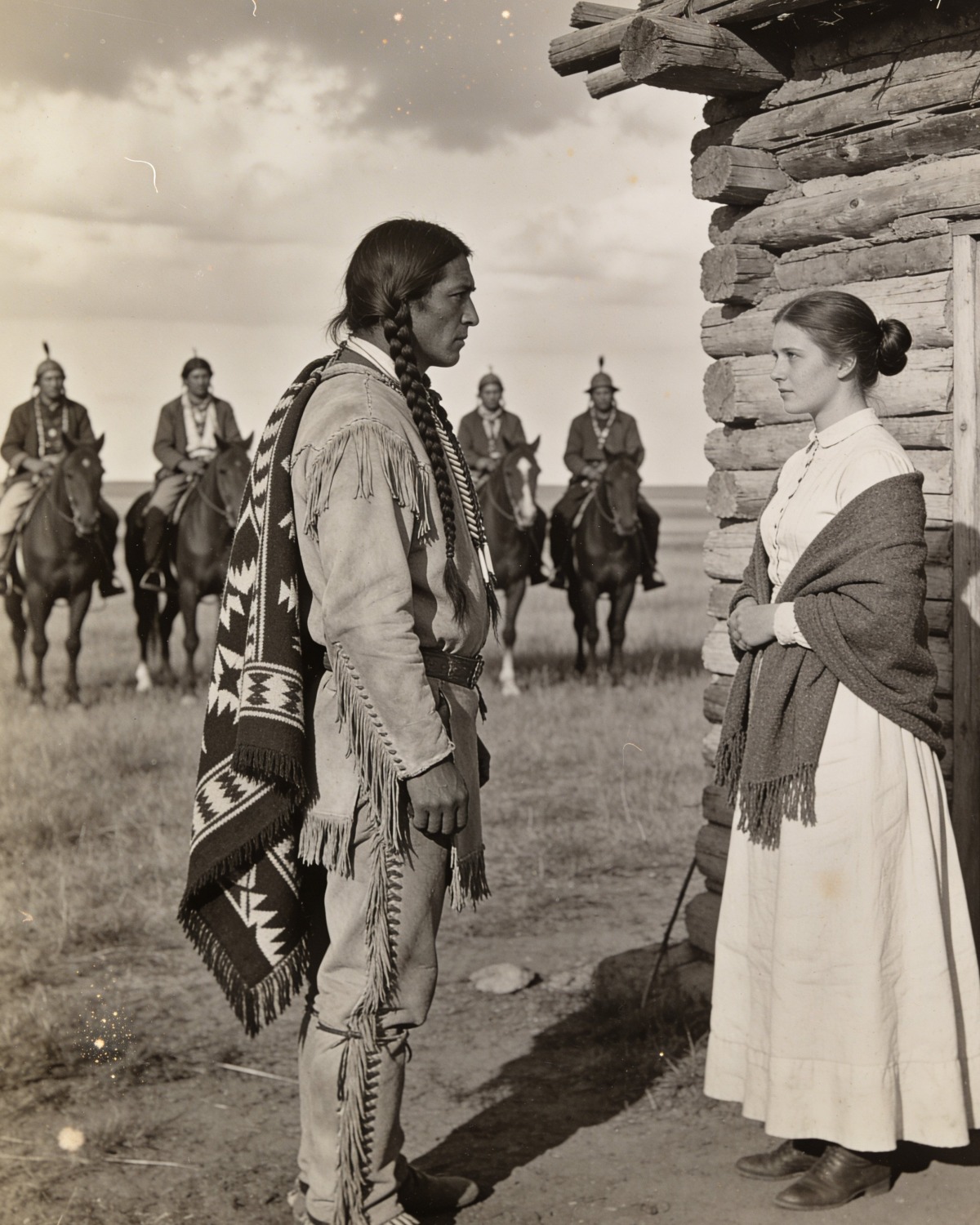
To accept meant leaving behind the only life he had ever known. To refuse meant dishonoring his father’s memory and the sacred oath of a leader.
His agitation, however, was about to be violently interrupted.
In Redemption Gulch, Sheriff Cain’s dismissal and Kora’s strange story had been the spark Sterling Croft needed. He saw his chance to seize Aonathy’s spring, not through legal means, but through brute force, disguised as a feigned concern for justice.
He spread the story around the saloon, embellishing it with each telling. The seven Apaches were not peaceful pretenders. They were a band of warriors holding the poor, terrified Abanathy girl hostage.
He quickly gathered a dozen men, not concerned citizens, but criminals, vagabonds, and hitmen loyal only to Croft’s money. Sheriff Caine, out of cowardice or complicity, chose to look the other way, taking care of the paperwork and declaring the matter a civil matter outside his jurisdiction.
As night fell on the second day after Gochimin’s revelation, Croft and his men left Redemption Gulch, their canteens full of whiskey and their minds set on violence. Their plan was simple: arrive on horseback, kill the Apache under the guise of a rescue, and convince the grateful Kora to sell her land for their own safety.
If she had been ungrateful, they would have taken care of her too.
Kora was sitting on the porch, watching the stars begin to appear in the twilight sky, when she heard it. Not the silent terror of Apache moccasins, but the heavy, clumsy thump of shod horses, too many of them moving too fast.
She grabbed her rifle, her heart pounding. From the Apache camp, a low, sharp whistle pierced the air: a signal. Gochimin and his warriors had heard it, too. They blended into the rocks and shadows at the foot of the ridge, becoming invisible, their rifles ready.
Gochimin walked quickly and silently towards the cabin.
“Come in,” he hissed urgently as he reached the porch. “It’s not a patrol. They’re there, angry.”
“Who?” Kora asked, her knuckles white on the butt of her rifle.
“The man from the city,” Gochimin said. “He who covers your waters. He comes to wage war.”
There was no more time for questions. The group burst into the valley, a disorderly mob of men led by Sterling Croft. They weren’t silent. They shouted, their voices thick with alcohol.
“All right, savages, the party’s over!” Croft shouted, bringing his horse to a screeching halt. “Let the woman go, and perhaps we’ll let you live.”
His men, pistols and rifles at the ready, looked forlorn in the fading light. They stood in stark contrast to the discipline of the Apaches, a pack of snarling dogs clashing with a silent pride of lions.
“This is my land!” Kora shouted from the door of her hut, aiming her rifle. “You’re the ones trespassing. Get out.”
Croft laughed. “Are you playing along, young lady? Don’t worry, we’ll save you.”
He raised his gun. “Last chance, pagans.”
The first shot wasn’t fired by the Apache or Kora. It came from one of Croft’s drunkest men. A blank shot that splintered the cabin doorframe inches from Kora’s head.
That was the end of the talks. The world erupted in a cacophony of gunfire.
From the rocks, Apache rifles responded with deadly accuracy. Two of Croft’s men were thrown before they could even fire a second shot. The warriors fired, moved, and fired again, constantly shifting positions, giving the impression of being outnumbered three to one.
They weren’t in a fight. They were on a hunt.