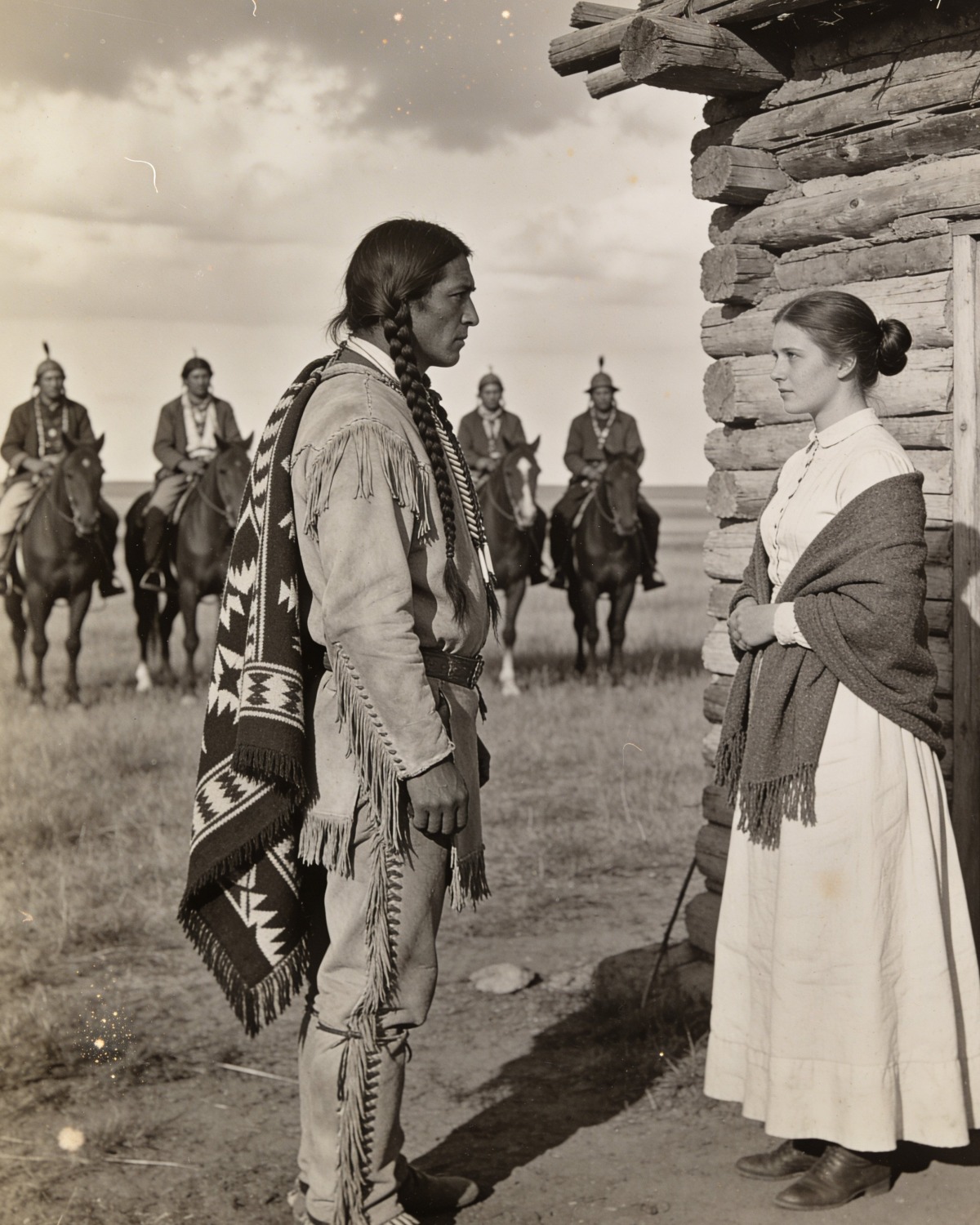
Yet the central question remained unanswered, hanging in the air as thick as the summer heat. Why? Why her?
It couldn’t have been her beauty. The sun and wind had marked her face, and her hands were calloused and rough. It couldn’t have been her homeland. They were mountain people, not farmers. The mystery tormented her.
One evening, as the sun burned in the western sky, Gotchimin approached the hut alone. He stopped on the line she had drawn in the earth long ago, a line that now seemed to symbolize a chasm between two worlds.
“Kora Abernathy,” he called respectfully. “May I speak to you? It’s time you knew the reason.”
Kora, who was cleaning her rifle on the porch, hesitated. Her fear had been replaced by a deep, irresistible curiosity. She nodded, putting the rifle down but keeping it within reach. “Speak.”
Gochimin didn’t cross the line. He stood there, a tall, imposing silhouette against the fading light, and began to tell a story.
“Sixteen years ago,” he began in a low, resonant voice, “my father, the great chief Cochius, led a small band of warriors through these mountains. They weren’t raiding. They were returning to our stronghold in the Sierra Madre after a council with the Navajo. They were attacked by surprise, not by soldiers, but by Mexican bounty hunters, men who were hunting our people for gold.”
Kora listened, enraptured, as the pieces of a puzzle she had never known existed began to fall into place in her memory.
“The battle was fierce,” Gimin continued. “My father was seriously wounded. A bullet had shattered his leg. He could not ride. He ordered his warriors to leave him and save themselves. They refused, but the bounty hunters were approaching. My father hid in a small cave, preparing to die fighting so his men could escape. He was alone, his life fading with the sun.”
Gochimin paused, his dark eyes meeting hers in the twilight.
“But he wasn’t alone. A white man found him. A man with hair the color of corn silk and eyes like the summer sky. A man who lived right in this valley.”
Kora held her breath. “My father,” she whispered.
“Yes,” Goin said. “Orin Abernathy. He was hunting and heard the sounds of battle. He found my father dying. He could have left him there. He could have killed him himself and pocketed the reward. He did neither. He didn’t see an Apache, but a man in distress. He brought my father back to this cabin. He and your mother dressed his wound, set the bone, and hid him from the bounty hunters who searched the area for days.”
Fragmented images—the hazy, half-forgotten memories of a six-year-old—flooded through Kora’s mind. A strange, dark-skinned man in her father’s bed. Her mother’s whispers, urging her to be quiet. The smell of strange herbs, the low, guttural sounds of a language she didn’t understand.
It had all been true.
“For two weeks, your parents cared for my father until he recovered,” Gotchamin said, his voice filled with deep reverence. “They shared their meager food with him. They protected him at the risk of their own safety. When he was strong enough to travel, your father gave him a mule and enough food for the journey, showing him a secret pass in the mountains.”
“Before he left, my father made a promise. He swore loyalty to his blood and honor.”
Gotchimin stepped forward, his feet finally crossing the invisible line. He wasn’t a threat, but an emissary from the past.
“My father swore that the debt between the House of Kisa and the House of Abernathy would never be forgotten. He swore that our people would forever regard this land, this spring, not as a place to be conquered, but as a sacred place under our protection.”
And he made one last promise. He saw you, a little girl with your mother’s blue eyes, playing near the door. He said to your father: “One day, when she is a woman, my son will come. He will come to join our lineages. He will unite our families so that the debt of life you have given me will be repaid throughout all generations. The daughter of the man who saved my life will be honored as the wife of the man who will lead my people.”
The pieces fell into place with shocking clarity.
It wasn’t a whim. It wasn’t a conquest. It was a promise. A sacred oath sworn sixteen years earlier between a chief and a settler. It was a matter of honor, the most valuable coin in the Apache world.
“My father died two winters ago,” Gotchimin concluded softly. “His last words to me were about his debt to your family. He commanded me to keep his promise. I have not come to take a bride, Kora Abernathy. I have come to honor my father’s word, to offer you the protection of my name, the strength of my people, and to finally repay a blood debt. By joining us, you will seal the bond your father forged. You will ensure that this land will be protected by the Chirikawa forever. You will become one of us.”
Kora sank onto the porch steps, her legs suddenly weak. Her entire life, her entire conception of her place in the world, had been completely upended. Her father was not a simple farmer who died of fever. He was a man who, with a single act of compassion, had linked his daughter’s fate to that of a great Apache chief.
She looked at Gotchimin, truly seeing him for the first time. He wasn’t a suitor seeking a wife. He was a king’s son fulfilling a sacred duty. And the hand he extended to her wasn’t just a proposal of marriage, but the closing of a circle that had begun long ago with an act of kindness in the desert.
The choice before her was suddenly infinitely broader than she had ever imagined. It wasn’t about her loneliness or her fear. It was about legacy, honor, and a debt that could only be repaid by uniting two worlds.
The revelation left Kora shocked. She spent the next few days mentally reliving Gotchimin’s story. The Apaches of her land were no longer strangers. They were the embodiment of a promise made to her family.