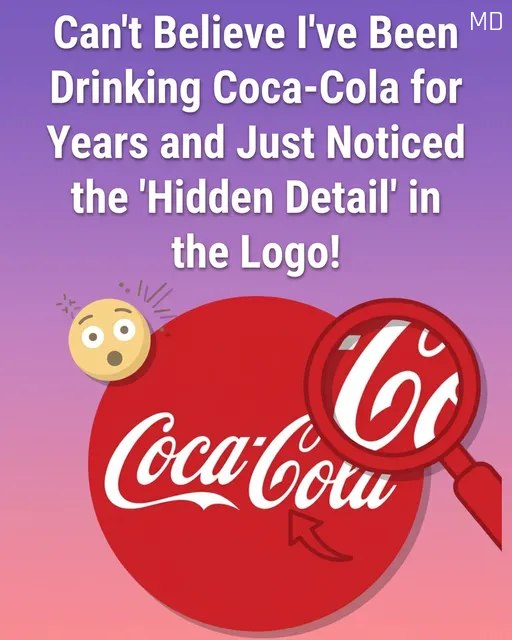
People Are Noticing an Interesting Detail in the Coca-Cola Logo

🧠 Why We See a Smile: Pareidolia

If it wasn’t intentional, why do so many people see it now? The answer lies in a psychological phenomenon called pareidolia.

  • Definition: The human brain’s natural tendency to find meaningful images (especially faces) in random or abstract patterns.
  • Evolutionary Link: Our ancestors needed to recognize faces quickly for survival; today, that wiring makes us see “faces” in the front of cars, in clouds, and in typography.
  • The Power of Association: Decades of Coca-Cola marketing focused on “Open Happiness” have primed our brains to look for positive emotional cues. When we look at the sweeping curve of the “C,” our brain “completes” the image as a smile because it matches the brand’s emotional identity.


📈 Evolution of a Brand’s Meaning

Recent Articles

My 9-year-old daughter baked 300 Easter cookies for the homeless — the next morning, a stranger showed up at our door with a briefcase full of cash. My daughter, Ashley, has always had a heart too big for her chest. Since my wife died, we’ve barely been making ends meet. We spent everything we had trying to save her from cancer. But when Easter came this year, Ashley told me she’d been saving up her own money to buy ingredients. “For the homeless,” she said. Her mom used to be one of them. She was thrown out by her parents when they found out she was pregnant with Ashley. When I met her, she had nothing — but she had the brightest smile and the sharpest mind I had ever seen. I fell in love with her. I took her and Ashley in. And from that moment on, Ashley became my daughter in every way that matters. So when Ashley said she wanted to help people like her mom once was… I didn’t stop her. For three nights straight, after school and homework, she baked. Her little hands worked nonstop. She found her mom’s old cookie recipe. She rolled every piece of dough herself. She decorated every cookie. She made three hundred cookies. On Easter, she handed them out one by one. She looked people in the eyes. She wished them a Happy Easter. Some of them smiled. Some of them cried. I stood there thinking it was the proudest moment of my life. I thought that was the end of it. The next morning, I was washing a mountain of dishes when the doorbell rang. I opened the door. An older man stood there in a worn-out suit, holding a scratched aluminum briefcase. His eyes were locked on Ashley. Before I could ask anything, he set the case down and opened it. I froze. Stacks of hundred-dollar bills — more money than I had ever seen in my life. “I saw what your daughter did yesterday,” he said, his voice shaking. “I want to give all of this to her.” My heart skipped. Then he added: “But you have to agree to ONE CONDITION.” My chest tightened. “What condition?” I asked. He stepped closer. He lowered his voice. And what he asked for in return made my blood run cold.

Leave a Reply

Your email address will not be published. Required fields are marked *